

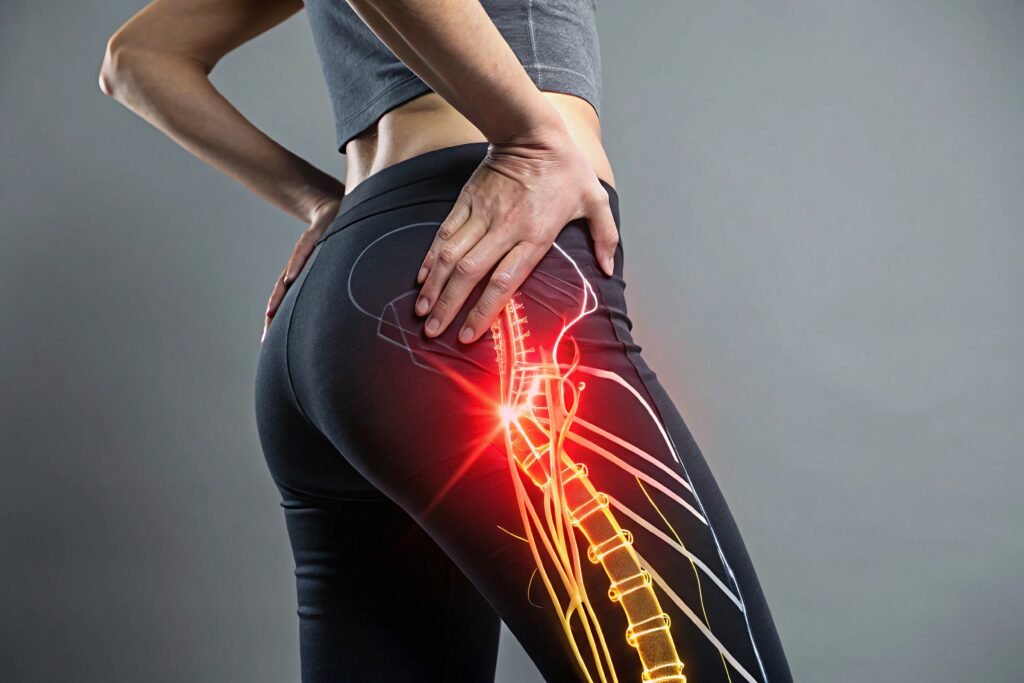
Lower back pain is one of the most common problems people experiences today. Long sitting hours, poor movement habits, heavy lifting, weak core muscles, stress, and reduced activity can all contribute to discomfort around the lower back.
But not every lower back pain is sciatica.
This is where many people get confused.
Someone may feel pain in the lower back and immediately think, “I have sciatica.” Another person may feel pain going into the leg and assume it is just normal back pain. In reality, both conditions can feel similar in the beginning, but they are not always the same.
The difference matters because the treatment approach depends on the correct assessment.
A general lower back pain problem may mainly involve muscles, joints, posture, stiffness, or movement overload. Sciatica usually involves irritation or compression of the sciatic nerve or nerve roots, often causing pain, tingling, numbness, or weakness that may travel from the lower back into the buttock, leg, foot, or toes. Cleveland Clinic describes sciatica as pain caused by irritation or compression of the sciatic nerve, which may involve pain, numbness, or tingling travelling into the leg.
That is why correct assessment is not optional. It is the starting point of effective care.
What Is Lower Back Pain?
Lower back pain usually refers to pain or discomfort around the lumbar spine, pelvis, hips, or surrounding muscles.
It may feel like:
- Dull aching pain
- Stiffness after sitting
- Pain while bending
- Pain while standing for long
- Tightness around the lower back
- Discomfort after lifting
- Pain that stays mainly around the back or hip area
In many cases, lower back pain is related to mechanical factors such as poor posture, muscle imbalance, reduced mobility, weak core support, or repeated strain during daily activity.
This type of pain may stay local to the back or may spread slightly toward the buttock or hip. But it usually does not follow a clear nerve pathway down the leg.
What Is Sciatica?
Sciatica is different because it involves nerve-related symptoms.
The sciatic nerve is the largest nerve in the body. It starts in the lower back, passes through the buttock, and travels down the leg. When this nerve or its nerve roots become irritated, compressed, or inflamed, symptoms may travel along that pathway.
Sciatica may feel like:
- Sharp pain going from the lower back into the leg
- Burning or electric-shock-like pain
- Tingling or pins and needles
- Numbness in the leg or foot
- Pain that becomes worse with sitting, bending, coughing, or sneezing
- Weakness in the leg or foot
Cleveland Clinic notes that sciatica symptoms may include burning or electric-shock-like pain shooting down one leg, numbness, tingling, and in more serious cases, muscle weakness or loss of bladder or bowel control.
This is why sciatica should not be treated like ordinary back tightness.
The Main Difference Between Sciatica and Lower Back Pain
The simplest difference is this:
Lower back pain usually stays around the back, pelvis, or hip area.
Sciatica usually travels from the lower back into the buttock and leg.
Lower back pain is often more related to muscles, joints, posture, stiffness, and movement patterns.
Sciatica is more related to nerve irritation, nerve compression, or nerve sensitivity.
But the real challenge is that both can exist together.
A person may have lower back pain with sciatica. Another person may have leg pain that looks like sciatica but is actually coming from muscle trigger points, hip problems, sacroiliac joint dysfunction, or other movement-related issues.
That is why guessing the diagnosis based only on pain location can be misleading.
Why Correct Assessment Matters
Correct assessment helps identify what is actually causing the symptoms.
Without assessment, treatment becomes guesswork.
For example, two people may both say:
“My lower back pain is going into my leg.”
But one person may have nerve irritation from a disc-related issue. Another may have tight hip muscles referring pain into the leg. Another may have poor pelvic control and muscle imbalance. Another may have spinal stiffness and weakness after prolonged sitting.
All of them may describe similar pain, but their treatment plans should not be the same.
A proper physiotherapy assessment may include:
- Pain history
- Movement testing
- Posture assessment
- Strength testing
- Flexibility assessment
- Neurological screening
- Straight leg raise or nerve-related tests
- Walking pattern observation
- Functional movement analysis
- Identification of red flags
NICE guideline NG59 covers assessment and management of low back pain and sciatica in people aged 16 and above, including non-invasive treatment approaches and assessment recommendations.
Why Self-Diagnosis Can Delay Recovery
Many people search online, watch exercise videos, and start doing random stretches for back pain or sciatica.
Sometimes this may help temporarily.
But sometimes it may make symptoms more sensitive.
For example:
If the pain is coming from nerve irritation, aggressive stretching may increase discomfort.
If the pain is coming from weakness and poor control, only massage may not solve the movement issue.
If the pain is coming from poor sitting posture and weak core support, only painkillers may not correct the contributing factors.
If the pain is from a condition that needs medical review, delaying assessment may not be appropriate.
This is why the first step should not be “Which exercise should I do?”
The first step should be:
“What is causing my pain?”
Common Causes of Lower Back Pain
Lower back pain may develop due to several factors, including:
- Prolonged sitting
- Poor workstation setup
- Weak core muscles
- Tight hip flexors or hamstrings
- Reduced spinal mobility
- Poor lifting mechanics
- Sudden increase in activity
- Muscle imbalance
- Previous injury
- Lack of movement
In office workers, gym users, drivers, and people with sedentary routines, the lower back often becomes overloaded because the body is not moving efficiently.
Pain then becomes a signal that the movement system needs attention.
Common Causes of Sciatica
Sciatica may be linked with:
- Disc bulge or disc herniation
- Spinal narrowing
- Degenerative spinal changes
- Nerve root irritation
- Poor spinal mechanics
- Prolonged sitting
- Hip and pelvic muscle tightness
- Weak core support
- Previous lower back injury
Cleveland Clinic lists conditions such as herniated discs, spinal stenosis, degenerative disc disease, spondylolisthesis, osteoarthritis, and other causes as possible contributors to sciatic nerve pain.
The important point is that sciatica is not only about pain. It may involve the nervous system. That is why treatment needs more precision.
Red Flags: When to Seek Immediate Medical Care
Most lower back pain and sciatica cases can be managed with appropriate conservative care, but some symptoms need urgent medical attention.
Seek medical care immediately if you experience:
- Sudden or worsening leg weakness
- Loss of bladder or bowel control
- Numbness around the saddle area
- Severe pain after trauma or fall
- Fever with back pain
- Unexplained weight loss
- Constant night pain that does not change with position
These symptoms may indicate a more serious condition and should not be ignored.
How Physiotherapy Helps After Correct Assessment
Physiotherapy is not just about giving exercises.
It starts with understanding the cause of pain and then building a structured plan.
For lower back pain, physiotherapy may focus on:
- Reducing muscle tension
- Improving spinal mobility
- Correcting posture
- Strengthening core muscles
- Improving hip mobility
- Teaching better sitting and lifting habits
- Restoring movement confidence
For sciatica, physiotherapy may include:
- Nerve-related movement exercises
- Gentle mobility work
- Pain-relieving positions
- Lower back and hip strengthening
- Movement correction
- Posture and sitting modification
- Gradual return to normal activity
The goal is not only to reduce symptoms. The goal is to restore better movement, improve function, and reduce repeated flare-ups.
The PhysioVeda PPCM® Approach
At PhysioVeda Medical Centre, assessment and treatment are guided through our PPCM® framework: PhysioVeda Posture Correction Matrix.
PPCM® focuses on four key areas:
Posture Assessment
We assess how your spine, pelvis, hips, and overall alignment may be contributing to your pain.
Pattern Correction
We identify faulty movement patterns during sitting, bending, walking, lifting, or exercise.
Core Stability
We work on deep stabilizing muscles that support the lower back and reduce unnecessary load.
Movement Restoration
We guide the body back toward better mobility, strength, and functional movement.
This approach helps us understand whether the problem is mainly lower back pain, sciatica, or a combination of both.
Why One Treatment Plan Does Not Fit Everyone
Two patients may have the same MRI report but different symptoms.
Two patients may have the same pain location but different causes.
Two patients may both have sciatica but need different exercise progressions.
That is why a professional assessment is important before starting treatment.
A good physiotherapy plan should be based on:
- Symptoms
- Movement findings
- Nerve involvement
- Strength levels
- Lifestyle habits
- Work demands
- Exercise routine
- Medical history
- Patient goals
When treatment is individualized, recovery becomes more structured and clinically guided.
The Bottom Line
Sciatica and lower back pain are connected, but they are not always the same.
Lower back pain may come from muscles, joints, posture, stiffness, or movement overload.
Sciatica usually involves nerve irritation and may cause pain, tingling, numbness, or weakness travelling into the leg.
Correct assessment matters because the wrong approach may delay progress, while the right assessment helps guide the right treatment plan.
At PhysioVeda Medical Centre, we focus on identifying the root contributing factors through detailed assessment and our structured PPCM® approach.
If your back pain is travelling into your leg, or if your lower back pain keeps returning, consider a physiotherapy assessment.
Early assessment may help you understand your condition better, start the right care, and move with more confidence again.
Your pain has a reason.
Correct assessment
helps find it.