

Pain does not always begin with an accident, fall, or visible injury.
For many people, it develops gradually.
It may start as mild neck tightness after work, lower-back discomfort after sitting, shoulder tension during exercise, or knee pain while climbing stairs. At first, the symptoms may settle with rest, stretching, massage, or pain-relieving medication.
But after a few days or weeks, the discomfort returns.
One possible reason is that the painful area may not be the only area involved. The body may be compensating for muscle weakness, reduced mobility, poor movement control, repetitive activity, or prolonged static posture.
This combination is commonly described as muscle imbalance and poor posture.
However, posture should not be blamed for every pain problem. There is no single “perfect” posture, and sitting or standing differently does not automatically mean that something is wrong. The problem usually develops when the body remains in one position for too long, repeatedly performs the same movement, or lacks the strength and mobility required to manage daily physical demands.
Over time, certain muscles may become overloaded while others contribute less effectively. This can change how joints are supported, how movement is distributed, and how the body responds to physical stress.
That is the hidden connection between muscle imbalance, posture, and persistent pain.
What Is Muscle Imbalance?
Muscles rarely work alone. They function in coordinated groups to move and stabilize the body.
A muscle imbalance may develop when related muscles do not share their workload effectively. This may involve:
- One muscle becoming stronger or more dominant than another
- Reduced strength or endurance in stabilizing muscles
- Tightness or reduced flexibility in certain areas
- Delayed muscle activation
- Poor coordination between muscle groups
- One side of the body works differently from the other
- Some muscles remain overactive while others are underused
For example, a person may have strong superficial abdominal muscles but reduced control of the deeper trunk muscles. Another person may have powerful quadriceps but reduced hip strength and ankle mobility.
The individual may appear strong, but their movement system may still be poorly balanced.
Muscle imbalance does not always cause pain. Many people have natural differences in strength, flexibility, and posture without experiencing symptoms. Problems are more likely to develop when the imbalance is combined with repetitive loading, fatigue, previous injury, inactivity, or inadequate recovery.
What Does Poor Posture Really Mean?
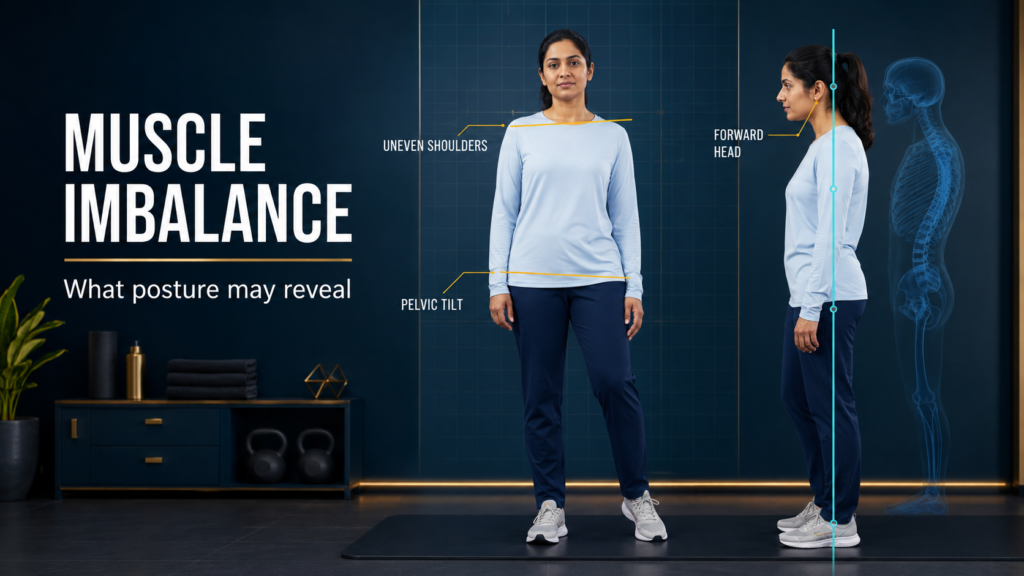
“Poor posture” is often described as sitting with rounded shoulders, standing with an uneven pelvis, or allowing the head to move forward.
But posture is more complex than how the body looks.
Posture is the position the body uses to manage gravity, movement, and external load. A posture may become uncomfortable when:
- It is maintained for a long time without movement
- The position places repeated stress on the same tissues
- The body lacks sufficient strength or endurance
- Joint mobility is restricted
- Workstation or activity demands exceed physical capacity
- The person repeatedly compensates around a painful or stiff area
For this reason, a more useful goal is not to remain perfectly upright throughout the day. It is to develop the strength, mobility, and body awareness needed to change positions comfortably and manage different physical demands.
The body usually benefits more from movement variety than from trying to hold one rigid posture all day.
How Muscle Imbalance and Posture Become Connected
Posture and muscle function continuously influence each other.
1. Prolonged Positions Create Muscle Fatigue
When you sit, stand, drive, or use a screen for long periods, certain muscles must remain active to support the body.
Even when the physical effort feels small, maintaining the same position for hours can gradually fatigue these muscles. As fatigue develops, the body may begin relying on surrounding muscles or passive structures for support.
This may contribute to:
- Neck and shoulder tension
- Upper-back stiffness
- Lower-back fatigue
- Hip tightness
- Reduced concentration and movement comfort
The posture itself may not be harmful. The problem is often the combination of duration, repetition, limited movement, and reduced physical capacity.
2. Weak Stabilizers Make Other Muscles Work Harder
Deep stabilizing muscles help control the spine, shoulder blades, pelvis, hips, and joints during movement.
When these muscles do not provide sufficient support, larger muscles may begin working harder to maintain control.
For example:
- Reduced deep neck-muscle endurance may increase demand on superficial neck and shoulder muscles.
- Reduced shoulder-blade control may contribute to repeated neck or shoulder overload.
- Reduced trunk control may increase demand on the lower-back muscles.
- Reduced hip strength may change how the pelvis, knee, and lower limb manage weight-bearing activities.
Research involving people with chronic lower-back pain has identified differences in hip range of motion, muscle activation, hip-abductor strength, and hip-extensor strength compared with individuals without lower-back pain. These findings show why assessment should look beyond the painful area, although they do not prove that one specific weakness caused the pain.
3. Tightness and Restricted Mobility Create Compensation
When one joint or body region does not move sufficiently, another area may move more to complete the same task.
For example:
- Limited upper-back mobility may increase movement demands on the neck or shoulder.
- Limited hip mobility may increase movement through the lower back.
- Restricted ankle movement may alter squat, walking, or stair mechanics.
- Tight chest muscles may influence shoulder-blade positioning during arm movement.
The body is highly adaptable. It will usually find a way to complete the movement.
However, repeatedly using the same compensation may increase strain on tissues that were not designed to handle the entire workload.
4. Repetition Reinforces the Movement Pattern
The body becomes efficient at movements it performs repeatedly.
This can be helpful during sport and exercise, but it can also reinforce less efficient patterns.
Examples include:
- Always carrying a bag on the same shoulder
- Holding a phone between the shoulder and ear
- Leaning toward one side while working
- Using one leg more while standing
- Repeatedly lifting with the same rotation
- Training certain muscle groups while neglecting others
- Returning to exercise after injury without restoring full movement
Over time, these habits may influence muscle endurance, coordination, flexibility, and joint loading.
5. Pain Creates Further Compensation
Pain itself can change how the body moves.
When an area becomes painful, the body may reduce movement around it and transfer more loads elsewhere. This is a normal protective response.
However, when the protective pattern continues for a long time, it may contribute to:
- Reduced mobility
- Muscle weakness
- Increased stiffness
- Fear of movement
- Reduced confidence
- Greater dependence on compensatory patterns
This can create a recurring cycle:
Discomfort → Reduced movement → Weakness or stiffness → Compensation → Increased sensitivity → More discomfort
Physiotherapy aims to interrupt this cycle by restoring movement confidence, physical capacity, and better coordination.
Common Patterns Associated with Persistent Pain
Neck and Shoulder Pain
People who spend long periods using computers or phones may develop reduced neck-muscle endurance, upper-back stiffness, shoulder-blade control problems, and increased tension around the upper trapezius and chest.
Forward-head posture has been associated with neck pain and disability in some adult populations. However, systematic-review findings also show that age and other factors influence this relationship, meaning forward-head posture should not automatically be considered the sole cause of pain.
Symptoms may include:
- Neck stiffness
- Shoulder heaviness
- Headaches associated with neck tension
- Pain between the shoulder blades
- Difficulty turning the head
- Discomfort while working or driving
Lower-Back and Pelvic Discomfort
The lower back works closely with the abdominal muscles, diaphragm, pelvic floor, hips, and gluteal muscles.
Reduced hip mobility, weak hip muscles, limited trunk endurance, or repeated sitting may increase the workload placed on the lower back.
Symptoms may include:
- Pain after prolonged sitting
- Stiffness while standing up
- Discomfort during bending
- Fatigue while standing
- Pain during lifting
- Reduced confidence with exercise
Lower-back pain is the leading contributor to disability among musculoskeletal conditions worldwide, highlighting the need for appropriate assessment and rehabilitation rather than relying only on temporary symptom management.
Hip and Knee Pain
The knee is influenced by how the hip, ankle, and foot control movement.
Reduced hip strength, limited ankle mobility, poor balance, or altered lower-limb control may affect activities such as:
- Walking
- Running
- Squatting
- Climbing stairs
- Landing
- Changing direction
The painful knee may require treatment, but assessment may also need to include the hip, pelvis, ankle, foot, and overall movement pattern.
One-Sided or Repetitive Pain
Repeatedly using one side of the body may contribute to uneven loading.
This may occur in:
- Racket-sport players
- Golfers
- Drivers
- Dentists
- Office workers
- Manual workers
- Parents carrying children
- People with previous injuries
- Individuals performing repetitive gym exercises
The goal is not to make both sides perfectly identical. The aim is to identify whether an important difference is affecting function, physical capacity, or symptom behaviour.
Signs That Muscle Imbalance May Be Affecting You
Consider a physiotherapy assessment when you notice:
- Pain repeatedly returning to the same area
- One side is feeling weaker or tighter
- Difficulty maintaining comfortable positions
- Reduced movement on one side
- Repeated neck, back, shoulder, hip, or knee tension
- Pain during specific movements
- Early fatigue while sitting, standing, or exercising
- Difficulty controlling squats, lungs, lifting, or reaching
- Previous injury followed by ongoing compensation
- Temporary relief from massage without lasting functional improvement
These signs do not confirm a muscle imbalance by themselves. A proper assessment is required to determine whether the symptoms are related to strength, mobility, coordination, joint function, nerve sensitivity, training load, lifestyle factors, or another condition.
Why Stretching Alone May Not Be Enough
Stretching can be useful when muscles or joints have limited mobility.
However, repeatedly stretching the painful or tight area may not address the reason it keeps becoming tight.
A muscle may feel tight because it is:
- Overworking to compensate for weakness elsewhere
- Protecting a sensitive joint
- Fatigue from prolonged activity
- Responding to limited mobility in another region
- Lacking strength at the end of its available range
- Being repeatedly loaded during work or exercise
In these situations, stretching may provide temporary relief, but the symptoms may be returned when normal activity resumes.
A 2024 systematic review found that strengthening interventions could influence cervical and thoracic posture, while stretching alone had more limited supporting evidence. The researchers also noted that effects varied by spinal region and that more research was required.
The right plan may therefore combine mobility work with strengthening, movement retraining, activity modification, and improved load management.
How Physiotherapy May Help
Physiotherapy does not focus only on making the body look straighter. It examines how the person moves, functions, and responds to physical demand.
1. Posture and Movement Assessment
The physiotherapist may assess:
- Sitting and standing positions
- Spinal and joint mobility
- Muscle strength and endurance
- Flexibility
- Balance and coordination
- Walking pattern
- Squat, lunge, bending, lifting, and reaching mechanics
- Workstation habits
- Exercise technique
- Previous injuries
- Activities that increase or reduce symptoms
The aim is to identify clinically relevant patterns rather than treating every natural postural difference as a problem.
2. Mobility Restoration
Targeted mobility exercises or joint techniques may be used when restricted movement is affecting function.
This may involve the:
- Neck
- Upper back
- Shoulders
- Lower back
- Hips
- Knees
- Ankles
Improving movement in a restricted area may reduce the need for compensation elsewhere.
3. Targeted Strengthening
Strengthening is selected according to assessment findings rather than using the same routine for everyone.
Treatment may focus on:
- Deep neck muscles
- Shoulder-blade stabilizers
- Rotator-cuff muscles
- Trunk and core muscles
- Gluteal muscles
- Hip abductors and rotators
- Quadriceps and hamstrings
- Foot and ankle stabilizers
Exercise therapy has moderate-certainty evidence supporting improvements in pain and function for many people with chronic nonspecific lower-back pain.
4. Muscle Re-Patterning and Motor-Control Training
Having strong muscles is not enough if they do not activate with appropriate timing and coordination.
Motor-control training helps the nervous system organize movement more efficiently. This may involve:
- Controlled spinal movement
- Shoulder-blade coordination
- Hip and pelvic control
- Balance exercises
- Functional lifting
- Walking or running retraining
- Gradual sport-specific movement
5. Ergonomic and Lifestyle Guidance
Ergonomic changes may reduce unnecessary strain, but equipment alone is rarely the complete solution.
Guidance may include:
- Changing position regularly
- Adjusting screen and chair height
- Supporting the feet
- Alternating between sitting and standing
- Planning short movement breaks
- Modifying repetitive work
- Improving lifting habits
- Managing training and recovery
- Gradually increasing activity tolerance
6. Manual Therapy and Symptom Management
Manual therapy, soft-tissue techniques, joint mobilization, taping, heat, or electrotherapy may sometimes be used to support comfort and movement.
However, passive treatment is generally most useful when combined with active rehabilitation. Long-term improvement usually requires the body to rebuild strength, endurance, mobility, and confidence.
What Research Tells Us
Musculoskeletal conditions affect approximately 1.71 billion people worldwide and are the leading contributor to disability. Back and neck pain are among the major conditions creating a need for rehabilitation.
Research examining posture and chronic pain shows that the relationship is real but not simple:
- Forward-head posture has been associated with neck pain in some adults, but factors such as age can influence the relationship.
- People with lower-back pain may demonstrate differences in hip mobility, muscle activation, functional movement, and hip strength.
- Strengthening and stabilization exercises may help improve pain, function, and postural control in people with chronic neck or lower-back symptoms.
- Exercise directed toward the cervical, shoulder, and shoulder-blade muscles has demonstrated benefits for some people with chronic neck pain.
Taken together, the evidence supports a balanced conclusion:
Posture and muscle imbalance may contribute to persistent pain in some individuals, but they are rarely the only factors involved.
Sleep, stress, general health, previous injury, work demands, physical activity, training load, pain sensitivity, and confidence with movement may also influence symptoms.
That is why individualized assessment is more reliable than assuming that one visible postural difference explains every pain problem.
The PhysioVeda PPCM® Approach
At PhysioVeda Medical Centre, posture and muscle-imbalance concerns are assessed through the PPCM®—PhysioVeda Posture Correction Matrix approach.
PPCM® examines the body as a connected movement system rather than treating only the painful area.
The approach focuses on:
Posture Assessment and Correction
Identifying positions and daily habits that may be contributing to repeated physical strain.
Pattern Correction
Assessing how the person sits, stands, walks, bends, lifts, reaches, trains, and performs everyday movements.
Core and Stability Training
Improving the coordinated support provided by the trunk, diaphragm, pelvic region, hips, and surrounding stabilizing muscles.
Muscle-Balance Restoration
Addressing relevant weakness, tightness, reduced endurance, overactivity, and poor coordination identified during assessment.
Movement Restoration
Progressing from controlled exercises to functional movements required for work, exercise, sport, and daily activity.
Lifestyle and Ergonomic Support
Helping the individual manage sitting time, work demands, training load, recovery, and repetitive movement habits.
The purpose is not to force every person into an ideal posture.
The goal is to help the body become stronger, more adaptable, better coordinated, and more capable of managing daily physical demands.
Why Professional Assessment Matters
Online posture videos and general exercise routines may provide useful education, but they cannot identify every reason behind persistent pain.
Two people with the same visible posture may require completely different treatment plans.
One person may need mobility work. Another may need strengthening. A third may require load modification, nerve assessment, medical review, or gradual exposure to movement.
A physiotherapist can:
- Screen for conditions requiring medical referral
- Identify relevant movement and muscle impairments
- Select exercises according to the individual’s needs
- Adjust intensity and progression
- Monitor symptom response
- Correct exercise technique
- Support a gradual return to normal activity
Treatment response varies between individuals and depends on the condition, duration of symptoms, general health, activity level, and consistency with rehabilitation.
When to Seek Immediate Medical Care
Posture-related discomfort is commonly managed conservatively, but some symptoms require prompt medical assessment.
Seek urgent care if pain is accompanied by:
- Sudden or progressive weakness
- Loss of bladder or bowel control
- Numbness around the groin or saddle region
- Severe pain following trauma
- Fever or unexplained weight loss
- Chest pain or breathing difficulty
- Loss of balance or coordination
- Constant night pain that does not change with position
- Significant swelling, redness, or warmth
These symptoms should not be assumed to result from muscle imbalance or posture.
The Bottom Line
Muscle imbalance and posture can influence how the body distributes load, controls movement, and responds to physical stress.
When some muscles repeatedly overwork while others lack sufficient strength, mobility, endurance, or coordination, the body may begin compensating. If the pattern continues, discomfort may become persistent and daily movement may become more difficult.
But posture is not destiny.
There is no single perfect alignment that everyone must maintain. The more meaningful goals are:
- Regular movement
- Adequate strength and endurance
- Comfortable mobility
- Better movement variety
- Gradual activity progression
- Appropriate recovery
- Individualized rehabilitation when symptoms persist
Take the First Step Toward Better Movement
At PhysioVeda Medical Centre, our physiotherapists assess posture, muscle balance, mobility, strength, movement patterns, and daily physical demands through the structured PPCM® approach.
Treatment is planned according to individual assessment findings and may include movement correction, strengthening, mobility training, manual techniques, ergonomic guidance, and functional rehabilitation.
If neck, shoulder, back, hip, or knee discomfort repeatedly returns, consider a professional physiotherapy assessment to understand which factors may be contributing to your symptoms.
Your posture is only one part of the picture. Understanding how your entire body moves is the first step toward improving function, confidence, and long-term movement health.
References
- World Health Organization. Musculoskeletal Health. WHO.
- Mahmoud NF, Hassan KA, Abdelmajeed SF, Moustafa IM, Silva AG. The Relationship Between Forward Head Posture and Neck Pain: A Systematic Review and Meta-Analysis. Current Reviews in Musculoskeletal Medicine. 2019.
- Pizol GZ, Miyamoto GC, Cabral CMN. Hip Biomechanics in Patients With Low Back Pain: What Do We Know? A Systematic Review. BMC Musculoskeletal Disorders. 2024.
- Warneke K, et al. Effects of Stretching or Strengthening Exercise on Spinal and Lumbopelvic Posture: A Systematic Review With Meta-Analysis. Sports Medicine–Open. 2024.
- Hayden JA, et al. Exercise Therapy for Chronic Low Back Pain. Cochrane Database of Systematic Reviews. 2021.
- Saini N, et al. Evaluating the Impact of Cervical Stabilisation Exercises on Chronic Neck Pain: A Systematic Review. Musculoskeletal Care. 2025.
- Exercise for Neck Pain.