

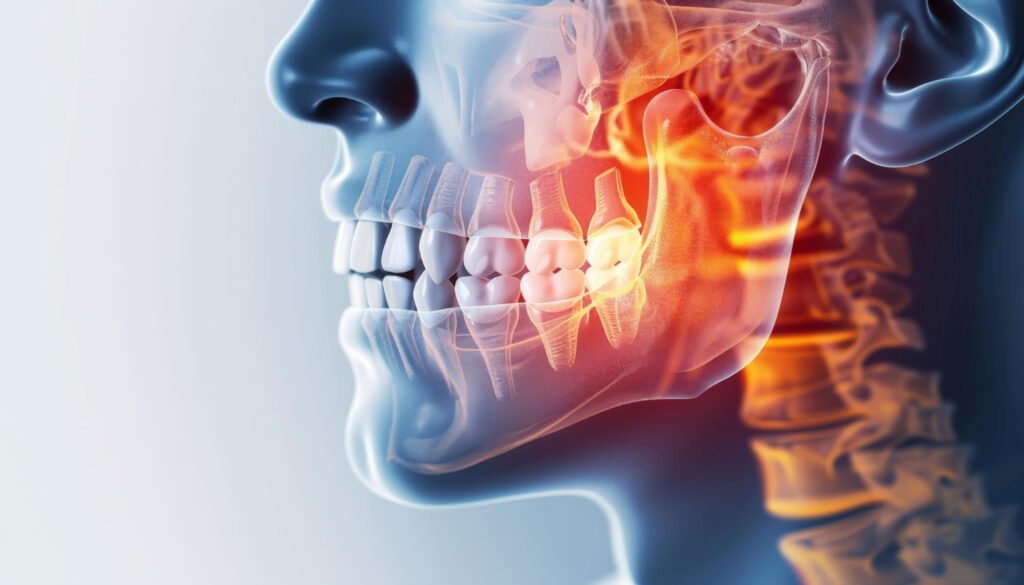
Jaw pain is not always just a problem with the jaw.
For some people, discomfort around the temporomandibular joint is accompanied by neck stiffness, facial muscle tightness, headaches, difficulty opening the mouth, or pain while chewing. This happens because the jaw, chewing muscles, head, and neck function as closely connected parts of the movement system.
The National Institute of Dental and Craniofacial Research (NIDCR) describes temporomandibular disorders, or TMDs, as a group of more than 30 conditions affecting the jaw joint and the muscles responsible for jaw movement. Importantly, TMJ refers to the joint itself, while TMD refers to the disorder.
Understanding this distinction and the relationship between the jaw and neck can help patients understand why physiotherapy may form part of a broader TMD management plan.
What Is TMJ Pain or TMD?
The temporomandibular joint sits just in front of each ear and connects the lower jaw, or mandible, to the skull.
Every time you:
- Talk
- Chew
- Yawn
- Swallow
- Bite
- Open or close your mouth
…the TMJ and surrounding muscles are working.
TMD can involve the joint itself, the muscles used for chewing, or both. NIDCR also recognizes headaches associated with TMD as one of the broad categories of these disorders.
Common symptoms may include:
- Pain around the jaw joint
- Tender or tired chewing muscles
- Jaw stiffness
- Difficulty opening the mouth normally
- Jaw locking
- Painful clicking or popping
- Facial pain
- Pain extending toward the neck
- Headaches associated with jaw symptoms
Interestingly, clicking alone without pain is common and does not necessarily require treatment, according to NIDCR.
The Jaw and Neck Are More Connected Than Many People Realise
Your jaw does not work independently from your head and neck.
Muscles around the jaw, skull, upper neck, shoulders, and cervical spine participate in coordinated activities required for speaking, swallowing, chewing, and maintaining head position.
Research has demonstrated an association between jaw disability and neck disability in people with TMD. Studies examining people with TMD have also identified differences in cervical muscle function and endurance compared with people without TMD. (PubMed)
This does not mean that every TMD is caused by the neck.
It means that when somebody has persistent jaw symptoms together with neck pain or stiffness, assessing both regions may provide a more complete understanding of their movement problem.
NIDCR itself notes that TMD pain can spread into the face or neck, and examination may include the head, neck, face, and jaw rather than examining only the joint.
Where Does Muscle Imbalance Come Into the Picture?
Muscle imbalance is better understood as a difference in how muscles are activated, coordinated, loaded, or fatigued rather than simply saying one muscle is “weak” and another is “strong.”
Around the jaw, important muscles include the:
- Masseter
- Temporalis
- Medial and lateral pterygoid muscles
Meanwhile, cervical and upper-body muscles help control head and neck position.
Studies examining muscle activity have demonstrated interactions between the masticatory and cervical muscle systems during jaw tasks. For example, research has observed activity changes in both chewing and neck muscles during resisted jaw movement.
Some people with TMD may therefore present with combinations such as:
Jaw tightness + neck stiffness
or
Chewing muscle tenderness + headache + upper-neck discomfort
or
Restricted jaw opening + cervical movement limitation
This is why simply treating the painful point around the jaw may not always address everything contributing to a person’s symptoms.
What Can Contribute to TMD?
There is rarely one universal explanation.
In fact, NIDCR states that the exact cause of TMD is unclear in many people. Current research suggests that biological factors, life and psychological stressors, pain processing, injury, and other individual factors may all contribute.
Possible contributing factors may include:
Jaw Clenching
Some people repeatedly tighten their jaw muscles during work, concentration, stress, exercise, or sleep.
Repeated muscle activity may contribute to soreness and fatigue.
Bruxism
Bruxism involves grinding or clenching the teeth. NIDCR lists jaw soreness, tightness, tired jaw muscles, headache, and facial pain among possible symptoms associated with bruxism.
Neck Dysfunction
For people who have both neck symptoms and TMD, cervical stiffness, reduced muscle endurance, or altered movement control may be relevant components of assessment.
Previous Trauma
Direct injury to the jaw or surrounding structures can contribute to some forms of TMD.
Repetitive Jaw Loading
Frequent gum chewing, nail biting, prolonged clenching, and similar habits can repeatedly load jaw muscles. NIDCR recommends becoming aware of and reducing these behaviours when relevant.
Stress and Pain Sensitivity
Stress does not mean that the pain is “in your head.”
Rather, stress may influence muscle activity, clenching behaviour, sleep, and how the nervous system processes pain. Current TMD research recognizes psychological and life stressors as potential contributors in some individuals.
When Should TMJ Symptoms Be Assessed?
Professional assessment may be appropriate when jaw symptoms repeatedly interfere with:
- Eating
- Chewing
- Yawning
- Talking
- Sleeping
- Working
- Exercising
- Normal mouth opening
Assessment is also worth considering when jaw pain occurs together with persistent neck discomfort, headaches, facial pain, or significant muscle tenderness.
However, jaw and facial pain are not always caused by TMD. Dental problems and other medical conditions can produce similar symptoms, so appropriate dental or medical assessment may sometimes be required. NIDCR specifically notes that clinicians may need to rule out other causes before diagnosing TMD.
How Physiotherapy May Help With TMD
Physiotherapy for TMD is not simply about massaging the jaw.
A physiotherapy assessment may consider the jaw, neck, muscles, movement patterns, habits, and functional limitations together.
Treatment depends on the individual’s assessment findings.
- Jaw Movement Assessment
The physiotherapist may evaluate:
- Mouth-opening range
- Jaw movement symmetry
- Pain during movement
- Muscle tenderness
- Functional movements
- Clicking or locking symptoms
- Neck Assessment
When neck symptoms are present, cervical movement, muscle function, and neck-related limitations may also be assessed.
This is particularly relevant because jaw and neck disability have been shown to be associated in people with TMD.
- Therapeutic Exercise
Exercises may be used to support:
- Controlled jaw opening
- Jaw coordination
- Muscle function
- Cervical control
- Neck mobility
- Functional movement
NIDCR recognizes physical therapy as one conservative approach to TMD management.
- Manual Therapy
Depending on the condition and clinical assessment, manual techniques may be directed toward the jaw muscles, soft tissues, or cervical region.
Research suggests that manual therapy can support improvements in pain and function for some people with TMD, although outcomes vary and treatment should be individualized.
- Jaw Habit Education
Patients may be guided to recognize behaviours such as:
- Persistent clenching
- Gum chewing
- Nail biting
- Holding the teeth together unnecessarily
- Repetitive jaw tension
NIDCR specifically includes reducing these habits as part of conservative TMD self-management.
- Relaxation and Movement Awareness
Where muscle tension or stress-related clenching is relevant, relaxation strategies, breathing awareness, and behavioural changes may complement physical rehabilitation.
What Does the Evidence Say About Physiotherapy?
Current evidence supports physiotherapy as a conservative treatment option, while also showing that TMD is complex and no single treatment is appropriate for every patient.
NIDCR states that physical therapy aims to maintain, improve, or restore movement and physical function, and reports that research suggests manual therapy may improve function and relieve pain in some people with TMD.
Research has also investigated treating the neck in people with TMD. A 2023 randomized study reported short-term improvements in pain and jaw function after cervical manual therapy in women with TMD.
More recent research examining neck rehabilitation has similarly found potential short-term benefits for pain outcomes in people with muscular TMD, although researchers continue to call for stronger evidence regarding long-term outcomes.
A randomized clinical trial published in 2025 also investigated combinations of therapeutic exercise, education, and manual therapy for chronic TMD, reflecting the increasing focus on multimodal rehabilitation rather than one isolated treatment technique.
This supports an important clinical message:
TMJ rehabilitation should be individualized.
The jaw, neck, muscle system, daily habits, symptoms, and functional difficulties should all be considered rather than assuming every patient has the same problem.
The PhysioVeda PPCM® Approach to Jaw and Neck Rehabilitation
At PhysioVeda Medical Centre, our existing PPCM® approach looks at posture, muscle balance, coordination, and movement as interconnected parts of rehabilitation. This same movement-system philosophy is used across PhysioVeda rehabilitation programs.
For someone presenting with TMD-related jaw and neck symptoms, assessment may therefore consider:
Posture & Movement Assessment
Understanding how the head, neck, jaw, and upper body are functioning together.
Muscle Balance Assessment
Identifying areas of excessive muscle activity, reduced control, tenderness, or fatigue.
Jaw Movement Re-education
Supporting smoother and more controlled jaw movement where appropriate.
Cervical Mobility & Control
Addressing relevant neck restrictions or movement difficulties.
Individualised Exercise
Using exercises selected according to the person’s assessment rather than a generic TMJ routine.
Lifestyle & Habit Guidance
Helping patients identify jaw-loading behaviours that may be contributing to symptoms.
The objective is not to claim that one posture or muscle is responsible for every case of TMD.
Instead, it is to understand which factors are relevant to that individual patient.
Conservative Care Matters
One of the most important recommendations from NIDCR is that people with TMD generally begin with conservative approaches and use caution before undergoing procedures that permanently alter the teeth, bite, or jaw joint.
Physiotherapy may form one part of that conservative management strategy, particularly when movement limitation, muscle tenderness, neck symptoms, or functional difficulties are present.
Depending on the condition, collaboration between a dentist, medical practitioner, orofacial pain specialist, and physiotherapist may provide the most appropriate approach.
The Bottom Line
Jaw pain may be more complex than it first appears.
The TMJ, chewing muscles, neck, and surrounding movement system interact continuously throughout everyday activities. Research also demonstrates an association between TMD and cervical symptoms in a proportion of patients.
Physiotherapy may support TMD management through:
- Jaw movement rehabilitation
- Therapeutic exercise
- Cervical rehabilitation when appropriate
- Muscle and soft-tissue techniques
- Movement re-education
- Jaw habit awareness
- Individualised guidance
The appropriate treatment depends on the type of TMD and the person’s individual findings, and results can vary.
Take the Next Step
If jaw pain, jaw stiffness, muscle tightness, or associated neck discomfort is affecting chewing, talking, movement, or daily activities, consider a professional assessment.
At PhysioVeda Medical Centre, physiotherapy care can assess the relationship between your jaw, neck, muscle function, and movement patterns and develop an individualised rehabilitation plan based on your clinical findings.
Move better. Understand your body better. Support better function.
This article is educational and does not replace individual medical or dental assessment.
I also kept the copy within the DHA-style language rules in your uploaded checklist using phrases such as “may help,” “support,” and “individual response varies” rather than guaranteed recovery, cure, one-session, or absolute outcome claims.